Parallel parking is one of the three reversing exercises on the practical driving test, and it worries more learners than almost anything else. It does not need to. Once you see it as a shape rather than a guess, it becomes a routine you can repeat.
You drive past the gap, stop beside the car in front, then reverse in. There are five steps, and the steering wheel only ever makes four turns: left, right, right, left, one full turn each time. It finishes with the wheels exactly where they started.
How to parallel park, step by step
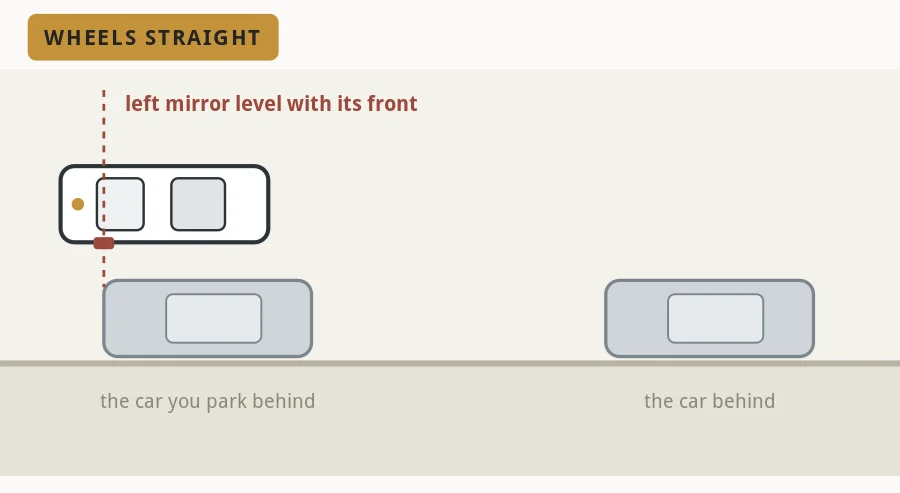
Each diagram is seen from above, with the kerb along the bottom. They are not to scale, and your own reference points will shift a little with the car you drive and how your seat is set.
Step 1: Line up beside the car in front
Drive past the gap and pull up alongside the car you are parking behind, about a door's width out from it. Your left door mirror should be level with the front of that car, and your front wheels should be straight.
Watch: Handbrake on, reverse gear in so your reversing lights show, then a good look all round before anything moves.
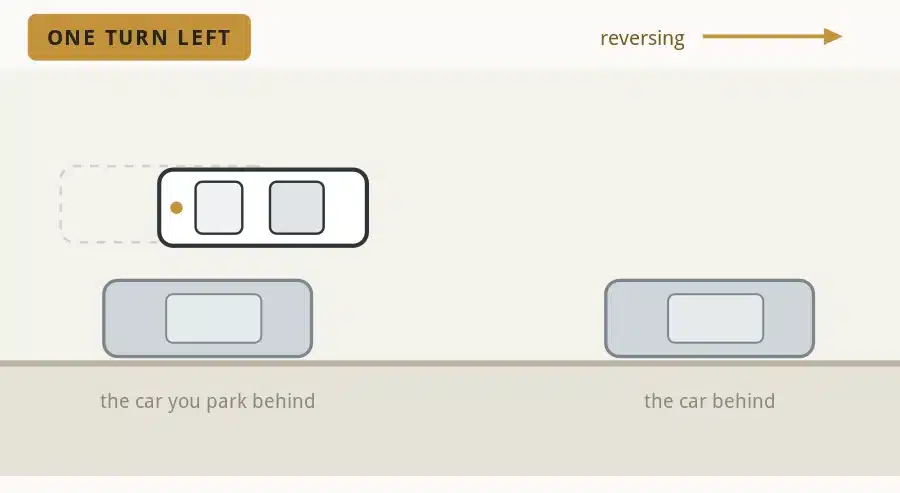
Step 2: Reverse back, then one turn left
Look back through the rear passenger window and reverse slowly. When the back of the car in front reaches the middle of that window, take one full turn left on the steering wheel.
Watch: Keep to walking pace. If you need to stop and look, stop and look.
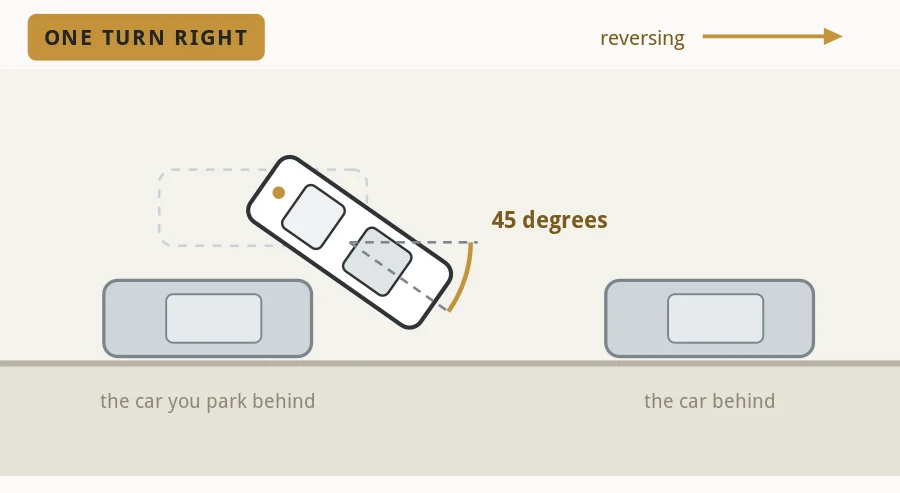
Step 3: Let the back swing in, then one turn right
Keep reversing and the back of your car comes round towards the kerb. When the car reaches about 45 degrees, one full turn right brings the wheels back to straight.
Watch: The front of your car swings out into the road as this happens, so look forward as well as back.
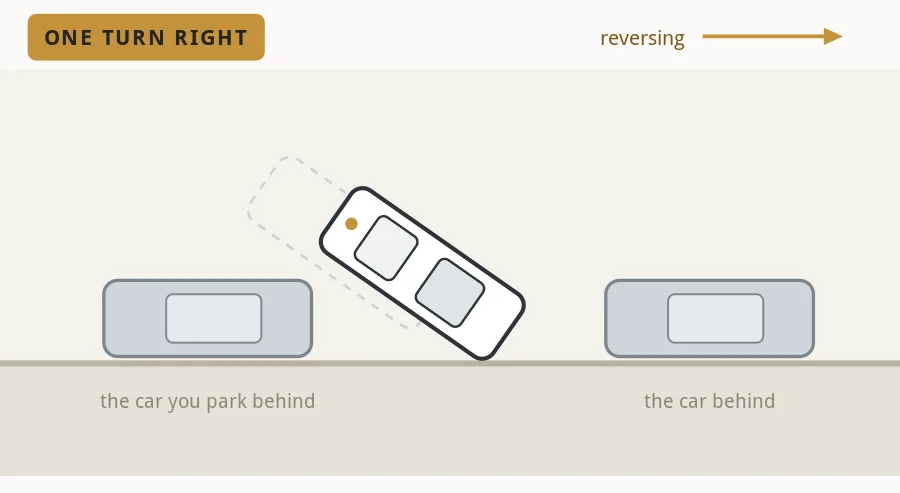
Step 4: Clear the corner, then one turn right
Reverse straight on that angle until your front wing is past the back of the car in front. Then one full turn right, which swings the front of your car in towards the kerb.
Watch: Watch the kerb in your left mirror from here on.
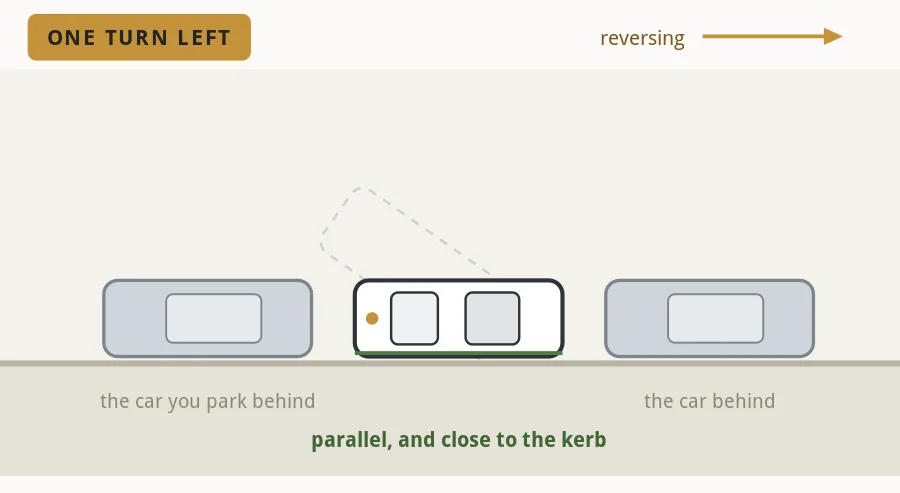
Step 5: Straighten up and stop
As the car comes parallel with the kerb, one full turn left puts the wheels straight again. Stop with room in front and behind you, then handbrake, neutral and a last look around.
Watch: Leave the car behind you enough space to get out.
If it goes wrong on the day
A parallel park that needs a correction is not a failed parallel park. The guidance examiners work to says so clearly:
- Not a fault: you stop, look round, or wait for a car to pass. That is good driving, and the examiner is marking observation and consideration for other road users.
- Driving fault: you pull forward once and have another go. The guidance calls this repositioning to correct a loss of control or accuracy. It is one driving fault, and you can pass with up to 15 of those.
- Serious fault: you shunt again and again with no plan. The guidance describes this as excessive repositioning to correct a complete misjudgement, or a significant loss of control.
- Serious fault: you finish somewhere you would not have chosen, such as too far out, badly angled or blocking the car behind.
The fault wording comes from the DVSA guidance for driving examiners, section 11. Our guide to what counts as a serious fault explains the marking in more detail, and our guide to the driving test manoeuvres covers the other two reversing exercises.
Common questions
Is parallel parking still part of the UK driving test?
Yes. It is one of three possible reversing exercises on the car practical test, alongside parking in a bay and pulling up on the right hand side of the road before reversing around two car lengths and rejoining the traffic. The examiner chooses one of the three on the day, so you may or may not be asked to parallel park.
Can you fail your driving test just for a bad parallel park?
Not for an untidy one. Repositioning the car to correct a loss of control or accuracy is recorded as a driving fault, and you can pass with up to 15 driving faults. It becomes a serious fault when there is excessive repositioning to correct a complete misjudgement, a significant loss of control, or a final parking position that is clearly wrong.
Am I allowed to pull forward and try again?
Yes. Correcting yourself is allowed. One correction, made calmly and with good observation, is marked as a driving fault and nothing worse. The problem is repeated shunting with no clear plan, because then the examiner is looking at a misjudgement of the whole manoeuvre rather than a single error.
Does touching the kerb fail your driving test?
The DVSA examiner guidance does not set a separate rule for touching the kerb during this exercise. It is assessed as part of control and accuracy. A light touch that you notice and correct sits at the driving fault end. Mounting or climbing the kerb is a loss of control, which is where it moves towards a serious fault.
Can I take my seat belt off to parallel park?
Yes. The law says you do not need to wear a seat belt if you are a driver who is reversing, or if you are supervising a learner driver who is reversing. Most people find it easier to leave the belt on, but if taking it off helps you turn and look properly, that is allowed. Put it back on before you drive away.
How close to the kerb should I finish?
There is no official measurement. The car should be close and parallel enough that it does not obstruct the road, does not force other drivers to steer around it, and can be reached from the pavement. If you would not be happy leaving your own car there, it is not finished.
Twenty minutes with an instructor beside you will do more for this manoeuvre than any amount of reading. We teach it the same way in manual and automatic cars, on real Oxford roads. Testing at the Oxford Cowley test centre? The Marsh Lane route includes a bay park too.
Book your driving lessons online, or see our driving lesson prices.